

Visual hotel marketing trends in 2026

The Era of Ambient Realism and Conversion Engineering
As AI began entering hotel and resort content creation, something subtle started happening:
the visuals became... flawless.
It is now approaching visual perfection.
And paradoxically, that’s exactly what’s making much of it feel untrue.
That sent me down a deep research rabbit hole — for myself, as a filmmaker and hospitality visual strategist.
What started as an exploration of perfection vs. authenticity quickly expanded into how hospitality brands communicate visually as a whole.
I distilled my findings into six practical trends shaping hospitality imagery in 2026 with practical guidelines, operational checklists, do's and don'ts, etc.
This isn’t an anti-AI take.
AI-generated content has a very real place in hospitality — especially for pre-opening phases, when the property isn’t ready yet to be filmed, and for creative approaches that wouldn’t be possible without AI (or would require very expensive CGI).
The challenge isn’t whether to use AI — it’s where, when, and why.

The hospitality marketing landscape of 2026 presents a clear paradox: visual content must function as machine-readable, data-rich assets that feed AI assistants, search engines, and booking platforms — yet at the same time, it must feel unmistakably human, sensory, and imperfect in order to break through growing “gloss blindness” caused by an oversaturation of AI imagery.
Through this research, it became evident that "Ambient Realism" has become the core currency of hospitality marketing. Visuals that feel observed rather than manufactured.
For the Thai market specifically, the convergence of national "Soft Power" strategies (the 5Fs: Food, Film, Fashion, Fighting, Festivals) with a "Value is the New Volume" tourism mandate requires a complete overhaul of visual narratives. Hotels can no longer simply market their facilities; they must market their role as curators of the neighbourhood and custodians of cultural authenticity.
This article outlines seven definitive trends for 2026 and breaks down how to execute each one.
Strategic Context: The Macro Environment of 2026
Before analysing specific content formats, it is critical to understand the three macro-forces dictating visual strategy in 2026.
1. The Trust Deficit and AI "Slop"
The avaialbility of generative AI tools has flooded the digital ecosystem with hyperrealistic but fake travel imagery. By 2026, consumers have developed a heightened scepticism toward overly polished content. A perfectly lit photo of a hotel lobby is now subconsciously flagged by the traveller’s brain as potentially synthetic or "catfished." This created a demand for "Verified Authenticity"—visuals that prove the existence and quality of the experience through motion, imperfection, and human presence.
2. The Shift from SEO to GEO (Generative Engine Optimization)
Search behaviours have migrated from typing keywords into Google to asking natural language questions to AI agents (like Gemini, ChatGPT) and searching visually on platforms like TikTok and Instagram. These platforms prioritize content that answers specific questions visually. "Show me a quiet hotel in Bangkok with a riverside pool" is a query that demands a specific video asset, not a generic gallery. Marketing teams must produce content that "feeds the machine" with clear auditory and visual answers.
3. Thailand’s "Value is the New Volume"
The Tourism Authority of Thailand (TAT) has pivoted aggressively toward high-value, sustainable tourism. For hotels, this means the visual narrative must shift from "volume" (crowded pools, bustling buffets) to "value" (privacy, craft, cultural immersion). The visual language of 2026 for Thai properties is rooted in the "New Thailand" vision, which emphasizes wellness, nuances of local culture, and soft power assets rather than mass tourism tropes.

Trend 1: Ambient Realism & The "Anti-Aesthetic"
What It Is
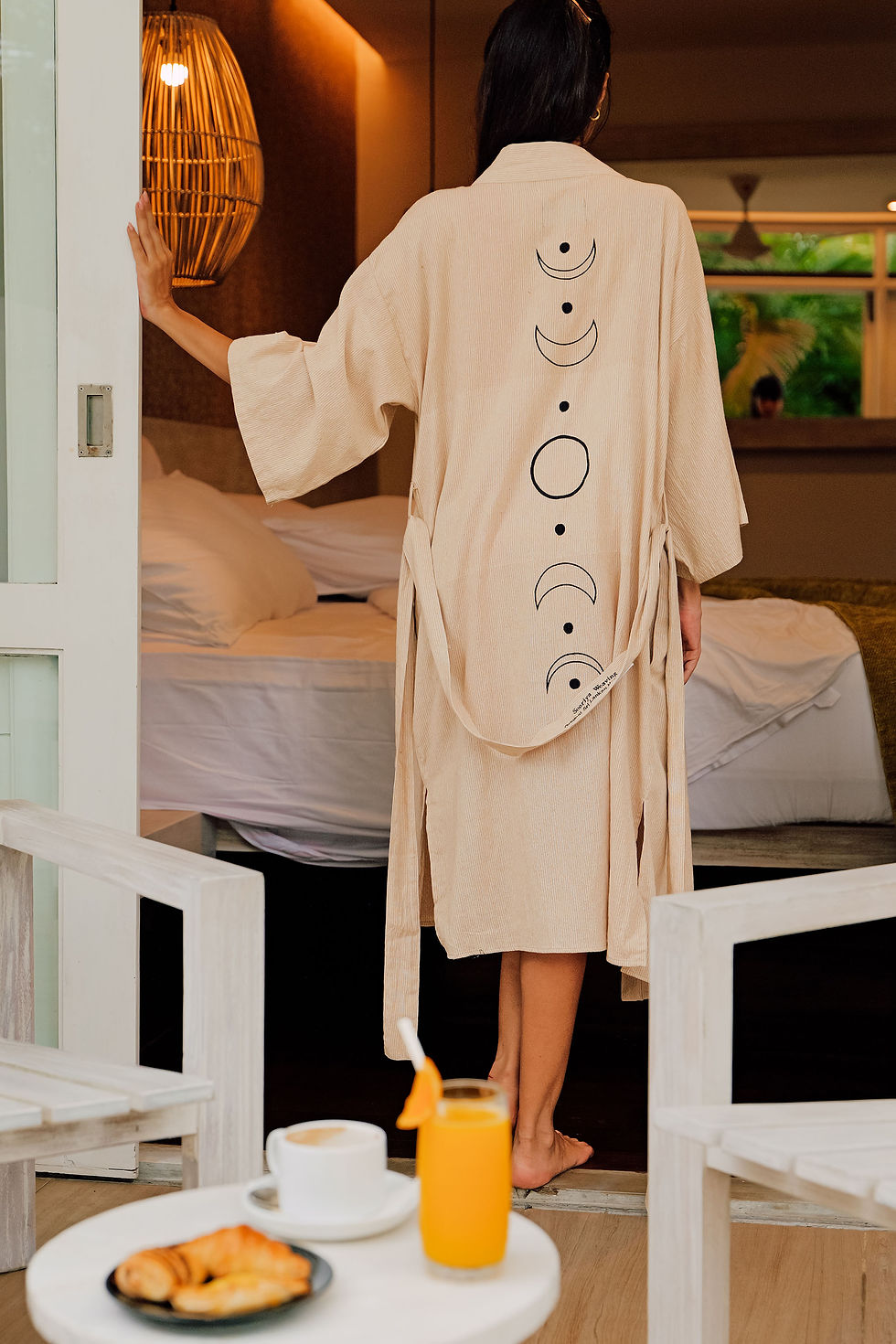
Ambient Realism is the strategic rejection of the "Instagrammable" perfection that dominated the previous decade. It is a visual style characterized by natural, often imperfect lighting, "messy" composition, and a focus on the "in-between" moments of a stay rather than the staged highlights. It mimics the aesthetic of a "photo dump" or a friend's private camera roll—images that feel captured rather than created. It embraces film grain, motion blur, and deep shadows to signal that the moment is real.
Why It's Rising
The rise of Ambient Realism is a direct counter-response to AI-generated imagery and the "Millennial Minimalist" aesthetic, which have both become commoditized. Travellers, particularly Gen Z and Alpha, view high-gloss production as "corporate propaganda." They associate "rawness" with "truth."
Furthermore, the "Quiet Luxury" movement has evolved into an appreciation for effortless existence. Staging a photo implies effort; capturing a candid moment implies confidence in the product's inherent quality. Stocksy’s "Signs of Life" report highlights this shift toward "high concept chaos" and human warmth as the antidote to digital sterility.
Practical Guidelines
Marketing teams must retrain their eyes and their photographers. The directive is no longer "make it look perfect," but "make it look like it felt."
Production Workflow:
Lighting: Abandon the complicated lighting setup. Use available natural light. If shooting at night, use direct flash (paparazzi style) to create hard shadows and a sense of energy, particularly for F&B and lifestyle events.
Composition: Move away from perfect symmetry. Use "POV" angles—shooting from the perspective of the guest sitting in the chair, not a wide angle from the corner of the room. Include human elements: a hand reaching for a glass, a bag left on the bed, a book open on the table.
Post-Production: Reduce clarity and structure settings. Add subtle grain. Warm up the white balance to mimic Kodak Portra or similar film stocks. Avoid HDR (High Dynamic Range) looks where shadows are unnaturally lifted.
Operational Checklist
Equipment Update: Equip social media teams with compact cameras (e.g., Fuji X100 series, Panasonic S9) or use specific "film look" apps (Dazz Cam) on phones, prohibiting the use of standard "beauty filters."
Briefing Photographers: Explicitly forbid "HDR" processing. Request "editorial" style over "architectural" style.
Do's and Don'ts
Do: Capture "imperfections" like condensation on a glass, steam from food, or ripples in a rug.
Do: Use flash photography for nightlife and dining to capture energy.
Don't: Use fisheye or ultra-wide lenses to distort room size. Authenticity includes spatial honesty.
Don't: Remove all traces of human existence. A pair of sunglasses on a table tells a story; an empty table does not.
Risks
The primary risk is the fine line between "aesthetic mess" and "actual mess." In the Mid-scale segment, this trend can backfire if not executed with a high-taste level. Additionally, relying too heavily on this for the main gallery can frustrate guests who simply want to see the bathroom layout. Balance is key.

Trend 2: Hyper-Local "Soft Power" Curation
What It Is
Thailand’s national strategy focuses on "Soft Power" (5Fs). Hotels must pivot from marketing facilities to marketing neighborhoods. The hotel becomes the curator of the local culture, using visual content to highlight local artisans, street food, festivals, and hidden gems. This is "Local Flavor" as a primary amenity.
Why It's Rising
"Value is the New Volume". High-value travelers want immersion, cultural capital, and "unseen" experiences. They view the hotel as a gateway, not just a shelter. If a hotel can visually demonstrate its connection to the local "cool" scene, it gains credibility and justifies a higher rate.
Where It Performs Best
Channels: Instagram Guides, YouTube (Vlog style), Website (Neighborhood Guide), Interactive Maps.
Segments:
Lifestyle: Core DNA. The hotel is the neighborhood hub.
Luxury: Curated Access. Showcasing "private access" to local culture (e.g., a private monk blessing).
Mid-scale: Utility. "Best cheap eats nearby."
Practical Guidelines
Content Pillars: The "Neighborhood Watch"
Allocate 20% of Budget: Dedicate 20% of the content production budget to shooting outside the hotel.
Collaborations: Partner with local "Soft Power" icons—a Muay Thai gym, a silk weaver, a street food legend. Create short documentaries or interviews with them.
Visual Style: Use "Ambient Realism" (Trend 1) to capture the gritty, vibrant texture of the street. Do not sanitize it.
Thailand Context
The 5Fs:
Food: Street food tours.
Fabric: Visiting local tailors or weavers.
Festival: Visual guides to Songkran/Loy Krathong in the local style (not just the tourist spots).
Film: Locations nearby that were in famous movies (film tourism).33
Fighting: Muay Thai matches or training.
Operational Checklist
Neighborhood Map: Create a digital or printed map of "Our Favorite Spots" and create a video for each spot.
Partner Agreements: innovative cross-promotion. "We shoot a video of your cafe, you give our guests 10% off."
TikTok Nearby: Assign responsibility to a local-facing role (concierge, F&B manager, duty manager)
1–2 short clips per day, max 15 seconds
Always: enable location tagging, keep ambient sound, film vertically, handheld

Trend 3: Generative Engine Optimization (GEO) & The Video Search
What It Is
GEO is the evolution of SEO for an AI-driven world. By 2026, travellers use platforms like TikTok, Instagram Reels, and AI-integrated search (Google’s SGE, Perplexity) as their primary discovery engines. These platforms prioritize content that provides answers through visuals.
Video content in this trend is not designed for "virality" (entertainment); it is designed for "utility" (information). It answers specific queries—"Best family hotel pool in Phuket," "How close is Hotel X to the BTS?"—using vertical video formats that algorithms can "watch" and index.
Why It's Rising
The consumer journey has compressed. Users no longer want to read a blog post to find an answer; they want to see it immediately. The "TikTok-ification" of search means that if a property does not have a video answer to a specific question, it does not exist in the consideration set for younger demographics.
Furthermore, AI algorithms now analyse the audio and text overlay within videos to determine relevance. A silent, aesthetic video has less SEO value than a video with a voiceover explaining the features.
Where It Performs Best
Channels: TikTok (Search), Instagram Reels (Search), YouTube Shorts, Google Business Profile (Video Updates).
Segments: All segments, but critical for Mid-scale and Lifestyle where "value for money" and location convenience are top decision drivers.
Practical Guidelines
Production Workflow: The "Video FAQ" Strategy
Keyword Research: Identify the top 20 questions guests ask the concierge or reservations team. (e.g., "Is the breakfast halal?", "Do you have a gym?", "Is the pool heated?").
Scripting for Algorithms: Write scripts that include the keywords in the first 3 seconds.
Bad: "Welcome to our pool."
Good: "Here is the salt-water infinity pool at [Hotel Name] in Bangkok, open until 10 PM."
Visual Proof: The video must visually demonstrate the answer. If the question is about the gym, show the specific equipment (dumbbells, treadmill brands), not just a wide shot of the door.
Operational Checklist
FAQ Audit: Compile a list of the top 50 guest questions from email inquiries and front desk logs.
Thumbnail Standardization: Ensure every video on TikTok/Reels has a "Title Card" thumbnail so users browsing the profile can instantly find the answer they need (e.g., text overlay "Breakfast Tour").
Caption Optimization: Write captions with natural language keywords, not just hashtags. Treat the caption like a mini-blog post.
Do's and Don'ts
Do: Use voiceovers (human or high-quality AI) to narrate the video. Algorithms prioritize audio context.
Do: Keep videos under 30 seconds. One question, one answer per video.
Don't: Hide answers. Don't make users watch 2 minutes of "lifestyle" footage to find out if there is a hair dryer.
Don't: Neglect Google Maps. Upload these vertical videos to the "Updates" section of your Google Business Profile.
Risks
The risk is "content decay." If a video answers a question (e.g., "Breakfast hours") and operations change, the video becomes misinformation. GEO content requires strict lifecycle management and deletion/updating protocols.

Trend 4: "All the Feels" – Sensory & Tactile Visuals
What It Is
"All the Feels" is a creative trend identified by Adobe and others for 2026, focusing on sensory engagement. It leverages the principles of ASMR (Autonomous Sensory Meridian Response) to evoke touch, taste, sound, and temperature through screens. In hospitality, this means marketing materials must convey the texture of the linens, the warmth of the lighting, the sound of the nature surrounding the resort, and the coolness of the pool water.
Why It's Rising
As screen time reaches saturation points, there is a psychological craving for physical sensation. Consumers are "touch-starved" digitally. Visuals that trigger "mirror neurons"—making the viewer feel what they see—are significantly more memorable and persuasive.
Additionally, the "Wellness" trend in 2026 has expanded beyond spa treatments to include "sensory regulation". Calming, textural visuals are seen as a form of mental wellness, positioning the hotel as a sanctuary.

Practical Guidelines
Production Workflow: The Macro & Audio Strategy
Visuals: Use macro lenses to shoot extreme close-ups.
Textures: The weave of a bathrobe, the bubbles in a champagne glass, the condensation on a window, the moss on a garden stone.
Motion: Slow motion (60fps or 120fps) makes liquids and fabrics look more "expensive" and heavy.
Audio: Audio is 50% of the "feel." Stop using generic pop music. Use Diegetic Sound (the actual sound of the scene). Capture the "crunch" of footsteps on gravel, the "sizzle" of a wok, the "chirp" of local birds.
Operational Checklist
Minimum Shot Duration for Sensory Moments: Enforce a minimum on-screen duration (2.5–4 seconds) for tactile or atmospheric shots to allow the sensation to register.
Cross-Platform Sensory Consistency: Ensure that the same sensory cues (sound, texture, atmosphere) are present across website, social, and in-property digital content.
Silence Planning: Intentionally design moments of low or no music to let natural sound and visual texture take focus.

Do's and Don'ts
Do: Use "Gimme Gummy" aesthetics for lifestyle brands—bright, squishy, tactile visuals (e.g., jelly desserts, inflatable pool toys).
Do: Prioritize audio quality. Bad audio ruins the sensory illusion instantly.
Don't: Fake it. Don't use a stock sound of "ocean waves" if your hotel is on a river. Guests will notice the dissonance.
Risks
The "Gimme Gummy" or hyper-tactile trend can veer into "gross" if not executed with high-end lighting (e.g., extreme close-ups of food being eaten). Caution is advised with food consumption shots; focus on food preparation instead.

Trend 5: Dark Social & The Private Sharing Economy
What It Is
"Dark Social" refers to the private sharing of content through encrypted messaging apps (WhatsApp, LINE, Messenger, DMs, Email) which cannot be tracked by traditional web analytics.
By 2026, it is estimated that over 70% of travel content sharing occurs in these private channels.
The trend is to create specific visual assets designed to be shared privately—assets that act as "digital currency" in a group chat.
Why It's Rising
Public social media sharing is declining due to "performative fatigue" and privacy concerns. The real influence happens in the "Family Vacation" WhatsApp group or the "Girls Trip" LINE group. If your content looks like an ad, it doesn't get shared there. If it looks like exclusive, useful, or aesthetic "insider info," it does.
Where It Performs Best
Channels: LINE (Thailand/Japan), WhatsApp (Global/Europe), Messenger (US), Instagram DMs.
Segments: All segments, but particularly strong for Group Travel, Weddings, and MICE, where decision-making is collective.
Practical Guidelines
Production Workflow: The "Shareable Card" Strategy
The "One-Pager" Vertical Video: Create a 15-30 second, text-heavy video that summarizes the entire offer (Room + Pool + Price + Date). This is a "video flyer."
The "Screenshot" Asset: Create Instagram Stories specifically designed to be screenshotted.
Design: "Hold to Screenshot" text overlay. Content: "3-Day Itinerary," "Packing List," or "Secret Menu."
Utility: High-contrast text, clear layout, branding in the center (so it's not cropped out).
Direct Download Links: On the website, provide a "Share with Friends" button that copies a direct link to a video or PDF card, not just the homepage URL.
Operational Checklist
Dark Social Audit: Review your "Share" buttons. Do they work? Do they pull the correct thumbnail image?
LINE OA Strategy (Thailand): Design a specific set of "Rich Menu" icons and "Broadcast" templates that are visually distinct from your Instagram content.
Sales Team Training: Equip sales teams with a folder of "WhatsApp-ready" vertical videos and images to send directly to clients, bypassing email attachments.
Do's and Don'ts
Do: Monitor "Direct" traffic sources in analytics. A spike in direct traffic usually indicates a Dark Social viral moment.20
Don't: Put gated forms on Dark Social assets. If a user shares a PDF, don't make the recipient sign up to read it. Friction kills the viral loop.
Risks
The inability to track attribution is the main risk. Marketing teams may undervalue Dark Social because they can't see the ROI in Google Analytics. Use "proxy metrics" like Direct Traffic growth and coupon code redemption unique to private channels.
Trend 6: The Commercial Team as Creators (LinkedIn)
What It Is
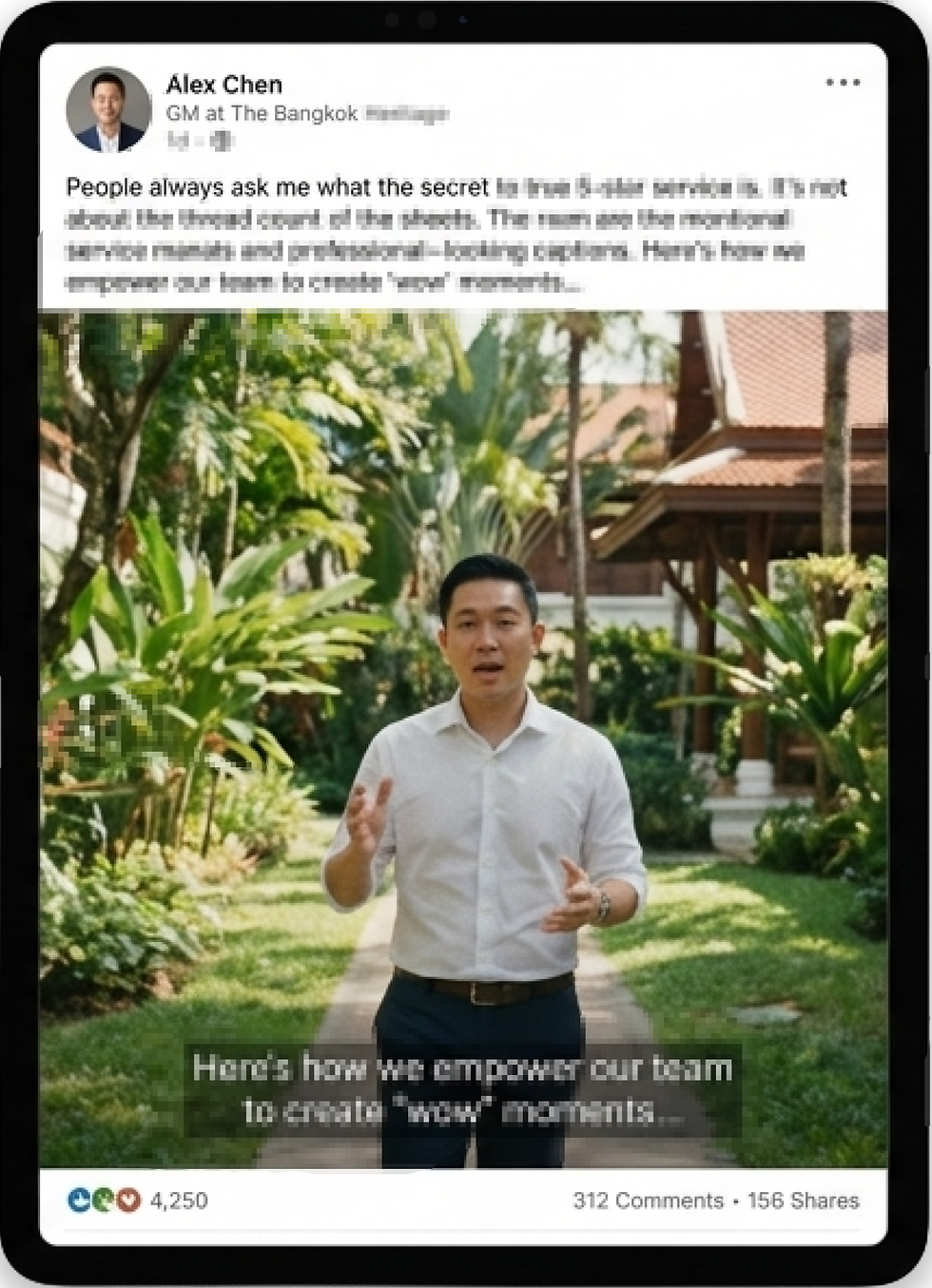
LinkedIn has transitioned from a recruitment platform to a primary B2B storytelling engine. In 2026, the hotel’s General Manager (GM), Director of Sales, and HR Director are expected to be active content creators. The trend moves away from sterile corporate updates ("We are humbled to announce...") to personal, video-first storytelling about leadership, culture, and operational excellence.
Why It's Rising
"People buy from people." Corporate travel managers and MICE planners want to know the values of the people running the property. A video of a GM passionately explaining the hotel’s sustainability initiatives builds more trust than a corporate sustainability report.
LinkedIn’s algorithm in 2026 heavily favors video and "personal" stories over company page posts.
Where It Performs Best
Channels: LinkedIn Personal Profiles (not just Company Page).
Segments:
Luxury: Essential. The GM is the face of the brand. Their reputation drives loyalty.
Mid-scale / Corporate: High. Critical for securing business travel contracts and MICE business.
Lifestyle: Medium. Useful for employer branding and attracting talent.
Practical Guidelines
Content Strategy: The "Leader’s Diary"
Format: "Walk and Talk" videos. Handheld (stabilized), candid, shot on a phone. The leader walking through the kitchen, the garden, or the lobby.
Topics:
Operational Insight: "Why we chose this coffee bean."
Culture: "How we celebrate staff birthdays."
Thought Leadership: "The future of luxury in Bangkok."
Frequency: Weekly video, daily engagement (comments).
Operational Checklist
Profile Optimization: Ensure key leaders have professional (but approachable) headshots and "Creator Mode" turned on.
Ghost-Creator Workflow: The marketing team should schedule 30 minutes/week to film the GM/DOSM, edit the footage, and write the captions for them to review and post.
Comment Strategy: allocate time for leaders to reply to comments. Engagement drives the algorithm.
Thailand Context
Content Angle: Focus on Thai Hospitality (Service Culture). Show the intricate training of the staff. Show the "wai," the flower arrangement, the respect for elders. This reinforces the global perception of Thai service excellence and leverages "Soft Power".
Networking: Thai business culture relies on relationships. LinkedIn video content acts as a "digital relationship" scaler.
Do's and Don'ts
Do: Show vulnerability. "We messed up this event, here is how we fixed it" is powerful content.
Don't: Treat LinkedIn like Facebook. Keep it professional, insightful, and value-driven. No "cat videos" unless the cat is the hotel mascot.
Risks
The risk is "Key Person Risk." If the GM builds a massive following and leaves, they take that audience with them. Mitigation: Diversify creators. Have the Chef, the Head Housekeeper, and the Sommelier also create content to distribute the brand equity.
Final Conclusion on hotel marketing trends in 2026
In 2026, the hotel marketing team is no longer just a publisher of ads; it is a broadcaster of reality. The winning properties will be those that can balance the technical demands of AI (GEO, Conversion Engineering) with the emotional demands of the human guest (Sensory, Authentic, Private). For Thailand, the opportunity is to leverage its inherent "Soft Power"—its chaos, its warmth, its flavors—and translate that into a visual language that is as vibrant and real as the destination itself.
If you want a quick, actionable reference - Download this PDF
Need help executing this?
Video. Photo. Visual Strategy.


Comments